Sunday, 18 December 2011

Cooperation: The Engineer and the Architect

This book, edited by Aita Flury, describes recent developments in the relation between architect and engineer in the design process, with focus on Switzerland and Germany. With contributions by Markus Peter, Adolf Krischanitz, Jürg Conzett, Mike Schlaich, Jospeh Schwartz and many others.

"This book provides a thorough description of just how varied and complex, how stressful and yet inspiring the cooperation between architect and engineer can be, and which projects become possible only through a cooperation of these two professions. [..] As such, it provides architects and students with the tools for future cooperation" (Birkhäuser.ch)


A snapshot of the realted panel discussion at the DAZ, on page 212/213.

Watch lectures by Fritz Neumeyer, Stefan Polónyi, Yves Weinand, Joseph Schwartz, and others, from the related symposium at the ETH Zurich online here.

Thursday, 17 November 2011

Watch Prof. Block’s Lecture Online

Prof. Block, founder of the BLOCK Research Group, has been invited on October 31, 2011 for his first departmental lecture at the College of Design, University of Minnesota, USA. Invited for the lecture series “Global Practices in Architecture”, he talked about “New Masonry Vaults: Learning from the old master builders to design a better future”.

Sunday, 23 October 2011

Modelling Funicular Structures

Funicular structures are structures whose geometry is based on the funicular polygon, a term from graphic statics. Such structures work mainly with axial forces, almost without bending. Typical examples are arches and cables.

At the IABSE-IASS Symposium 2011 in London, I presented novel parametric tools for structural design in early stages. These have been developed at the Chair for Structural Design, ETH Zurich. Download the paper here.


Based on concepts of graphic statics, custom Grasshopper components have been implemented that allow for the interactive modelling of a planar funicular polygon in Rhino. Straight lines are interpreted as external forces, axial forces in the funicular are represented by tubes, red tubes are in tension, blue tubes are in compression. The tube section is proportional to the magnitude of the axial force.


These tools facilitate intuitive modelling of funicular, hence efficient, structural systems.


Saturday, 15 October 2011

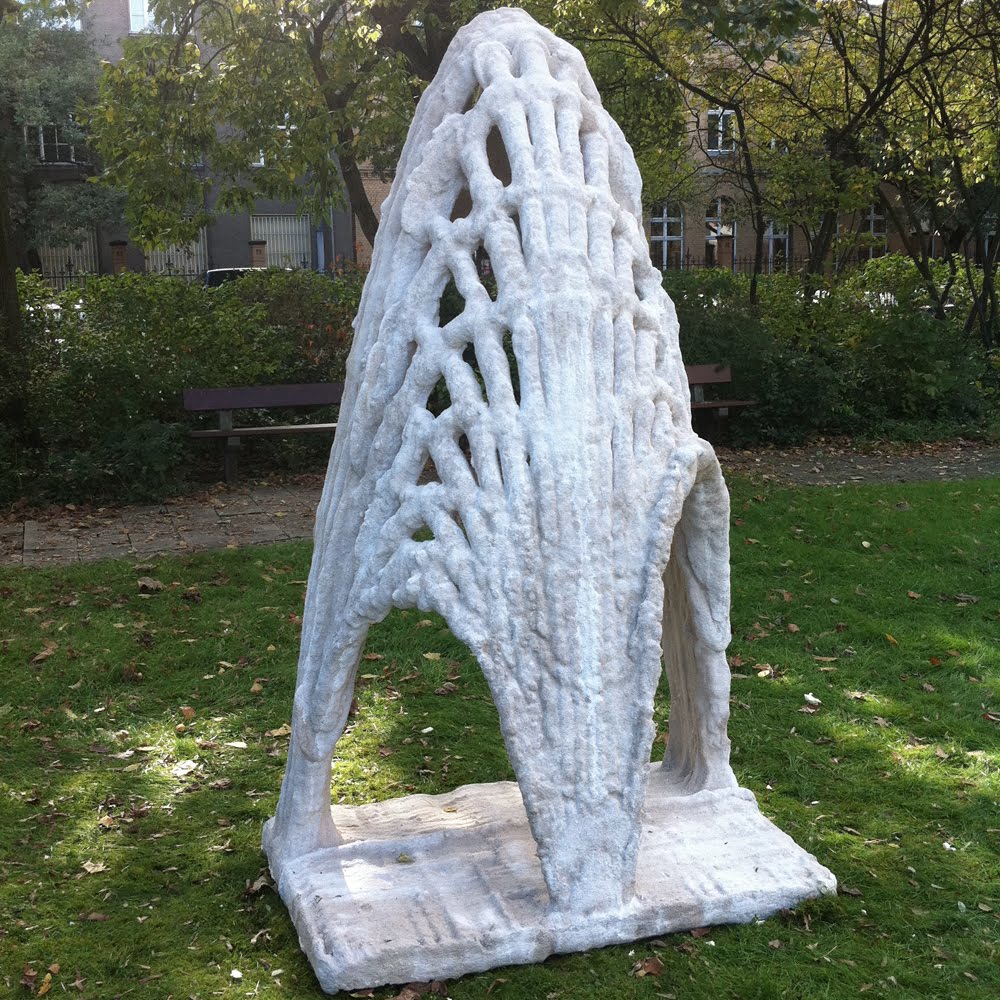
3D Printed Stone Vault


At the Design Modelling Symposium in Berlin, a 3d printed vault prototype, designed by Norbert Palz and Ricardo Gomes, has been exibited.


The vaulted structure has been additively fabricated using the d-shape techology, it is 3d printed from an artificial sandstone.


The prototype has been designed using RhinoVAULT.

Thursday, 6 October 2011

Padua Pavilion at ETH


Yesterday evening, on the ETH Zurich campus, the Padua Pavilion has been opened. It is a structure made of recycled timber, developed and built in two weeks by students of the studio Tom Emerson.


Structural consultancy and live music by Marcel Aubert.

Tuesday, 27 September 2011

Patents by Rem Koolhaas

Some of the famous architects and builders from the 20th century, as e.g. Le Corbusier, Buckminster Fuller, and Luigi Nervi, considered themselves as inventors and held several patents. Rem Koolhaas contributed in 2004 to this specific topic in an ironic way:


These and several other fake patents have been published in the book Content and the Bejing Manifesto.


In the same year, Rem Koolhaas also applied for a real patent, for a Panel for architectural design:


Tuesday, 30 August 2011

Open Source Architecture?

Time seems to be ripe for the development of an open design license for architecture. The manifesto of Open Source Architecture (OSArc) has been published few months ago in domus.


Yesterday, Daniel Davis raised the exciting question, whether Evolute is right to patent a certain geometry of a freeform roof construction.


This question is related to the discussion, whether it is right and possible to patent architecture in general. In 2007, there has been a heated discussion in Switzerland and internationally, about a patent by the Swiss architect Hans Zwimpfer, concerning a special housing type. After a fight with the Swiss architectural societies BSA and SIA, he managed to claim patent rights for his invention in Europe and the USA. While this US lawyer defends the idea of applying patent law to architecture in specific cases, this Swiss lawyer states that it is more appropriate to protect a work of architecture, as cultural artifact, by the more flexible copyright law, rather than the rigorous patent law.


Considering that patent law seems to be applicable to the rather fuzzy case of Zimpfer’s architectural innovation, there seems to be a good chance for Pottmann and RFR to defend their protected rights concerning geometric innovation of support structures.

The introduction of an Open Source Architecture license may be a way to actively defend intellectual property in architecture against protection by others.